
Roman Numerals 1 to 1000: Complete Chart and Conversion Guide
Roman numerals have been around for centuries, yet people still search for them every single day — mostly because they want to write a date on a tattoo, carve numbers into a memorial, or figure out what that fancy clock actually says.
Whether you want to know how to write your birthday in Roman numerals or you’re trying to figure out what 2026 looks like in this ancient number system, this guide covers everything you need — clearly, step by step, with no unnecessary confusion.
What Are Roman Numerals and Why Do They Still Matter?
Roman numerals originated in ancient Rome and were the standard way of writing numbers across Europe for centuries. Today, they show up in more places than most people realize: movie credits, clock faces, book chapters, tattoos, wedding dates, and even Super Bowl titles.
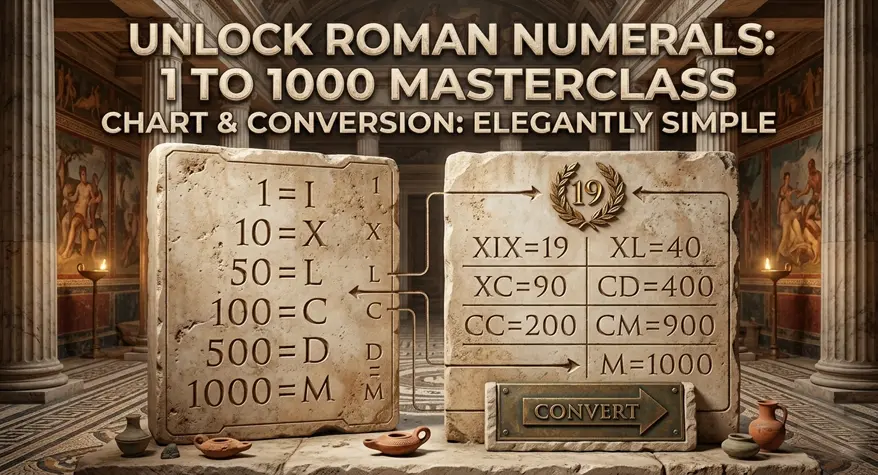
The system uses a combination of seven letters from the Latin alphabet:
- I = 1
- V = 5
- X = 10
- L = 50
- C = 100
- D = 500
- M = 1000
Everything from 1 to 1000 (and beyond) is built using combinations of these seven symbols. Once you understand how they combine, the whole system clicks into place.
The Core Rules Behind Roman Numeral Conversion
Before jumping into charts, you need to understand two basic rules that govern the entire system.
The Additive Rule
When a smaller or equal value symbol follows a larger one, you add them together.
- VI = 5 + 1 = 6
- XII = 10 + 1 + 1 = 12
- LXX = 50 + 10 + 10 = 70
The Subtractive Rule
When a smaller value symbol appears before a larger one, you subtract it. This is the rule that trips most people up.
- IV = 5 − 1 = 4
- IX = 10 − 1 = 9
- XL = 50 − 10 = 40
- XC = 100 − 10 = 90
- CD = 500 − 100 = 400
- CM = 1000 − 100 = 900
These six subtractive pairs are the only exceptions to the additive rule. Everything else just adds up from left to right.
Roman Numerals 1 to 100: Quick Reference Chart
| Number | Roman Numeral | Number | Roman Numeral |
|---|---|---|---|
| 1 | I | 51 | LI |
| 2 | II | 52 | LII |
| 3 | III | 53 | LIII |
| 4 | IV | 54 | LIV |
| 5 | V | 55 | LV |
| 6 | VI | 56 | LVI |
| 7 | VII | 57 | LVII |
| 8 | VIII | 58 | LVIII |
| 9 | IX | 59 | LIX |
| 10 | X | 60 | LX |
| 11 | XI | 61 | LXI |
| 14 | XIV | 70 | LXX |
| 15 | XV | 80 | LXXX |
| 19 | XIX | 90 | XC |
| 20 | XX | 99 | XCIX |
| 30 | XXX | 100 | C |
| 40 | XL | ||
| 50 | L |
Roman Numerals 101 to 1000: Key Milestones
You don’t need every number listed from 101 to 1000, but here are the anchor values that help you build any number in that range:
| Number | Roman Numeral |
|---|---|
| 100 | C |
| 150 | CL |
| 200 | CC |
| 300 | CCC |
| 400 | CD |
| 500 | D |
| 600 | DC |
| 700 | DCC |
| 800 | DCCC |
| 900 | CM |
| 1000 | M |
Once you know these, filling in the gaps is straightforward. For example:
- 547 = D (500) + XL (40) + VII (7) = DXLVII
- 999 = CM (900) + XC (90) + IX (9) = CMXCIX
- 2026 = MM (2000) + XXVI (26) = MMXXVI
What Is 2026 in Roman Numerals?
This one comes up often, especially on New Year content and commemorative items. 2026 in Roman numerals is MMXXVI.
Here’s how it breaks down:
- MM = 2000
- XX = 20
- VI = 6
Add them together: MM + XX + VI = MMXXVI
Simple once you see the structure.
How to Convert a Date to Roman Numerals Step by Step
This is the most common real-world use case — especially for tattoos, anniversary gifts, and memorial plaques. Here’s exactly how to convert a date like June 15, 1995, into Roman numerals.
Step 1: Separate Each Part of the Date
Break it into three components:
- Month: 6
- Day: 15
- Year: 1995
Step 2: Convert Each Number Individually
- 6 → VI
- 15 → XV
- 1995 → MCMXCV
- M = 1000
- CM = 900
- XC = 90
- V = 5
Step 3: Combine with Dots or Dashes
The most common format uses dots between each section: VI · XV · MCMXCV
Some people prefer dashes: VI-XV-MCMXCV
For tattoos specifically, the dot format tends to look cleaner and more traditional.
How to Write Your Birthday in Roman Numerals
Writing a birthday in Roman numerals follows the exact same process as above. Let’s walk through another example — March 22, 1990.
- March = 3 → III
- 22 → XXII
- 1990 → MCMXC
- M = 1000, CM = 900, XC = 90
Final result: III · XXII · MCMXC
That’s your birthday in Roman numerals, ready for a tattoo, a ring engraving, or a custom print.
If you want to skip the manual math, the Roman Numeral Converter at number-to-words.net lets you enter any number or date and get the result instantly — no risk of getting a permanent tattoo with the wrong numerals.
Common Mistakes When Writing Roman Numerals
Even people who think they know Roman numerals get caught out by these errors.
Mistake 1: Repeating a Symbol More Than Three Times
You should never write IIII for 4 — the correct form is IV. Similarly, XXXX is wrong; use XL for 40.
Mistake 2: Using Non-Standard Subtractions
Only specific pairs are valid for subtraction:
- I before V or X only
- X before L or C only
- C before D or M only
Writing IC for 99 is technically incorrect — the right form is XCIX.
Mistake 3: Subtracting More Than One Value
VX is not valid. You can’t subtract two values at once. Each subtractive pair involves exactly one smaller symbol before one larger symbol.
Mistake 4: Writing the Year Wrong
Years are the most error-prone part of date conversions. A single digit out of place changes the meaning completely. For anything permanent like a tattoo, always double-check your conversion using a reliable tool before committing. Number to words conversion rules are less about grammar and more about financial control.
Manual Conversion vs. Using a Tool
Doing Roman numeral conversions manually is great when you’re working with simple numbers — I, V, X, single-digit years, and so on. But once dates get involved, especially years in the 1900s, the potential for mistakes goes up significantly.
For instance, 1989 is MCMLXXXIX — a combination of seven distinct symbols that requires careful step-by-step breakdown. Get one symbol wrong and the whole year is off.
For users who regularly convert numbers, birthdates, or anniversary years, online tools can save a lot of time and eliminate guesswork entirely. The Roman Numeral Converter handles numbers from 1 to 3999 and gives instant, accurate results — which matters most when you’re preparing something that can’t be undone, like an engraving or a tattoo design.
If you also work with numbers in other formats, the tools available at number-to-words.net cover a wide range of number conversion needs in one place.
Roman Numeral Tattoo Tips
Since one of the most common reasons people look up Roman numeral date conversion is for tattoo purposes, here are a few practical notes:
Size affects readability. Longer dates like MMXXVI · XII · XXVII can become hard to read at small sizes — discuss sizing with your artist.
Always verify your date twice before sending it to your tattoo artist. Convert it manually and then run it through a converter to confirm that both match.
Choose a format and stick to it. Dots (·) are the most widely used separator. Slashes and dashes are also acceptable but less traditional.
Font choice matters. Classic serif fonts tend to complement Roman numerals best for tattoo work.
Summary
Roman numerals follow two core rules — additive and subtractive — built from just seven symbols. Once you understand those rules, converting any number from 1 to 1000 becomes a logical process rather than a memorization exercise.
For dates, the step-by-step method works well: convert the month, day, and year separately, then combine them with dots. For anything where accuracy is critical — tattoos, engravings, official documents — it’s worth confirming your result with the Roman Numeral Converter rather than relying on mental math alone.
Frequently Asked Questions
1. How do I write my birthday in Roman numerals?
Break your birthdate into three parts: month, day, and year. Convert each number separately using standard Roman numeral rules, then join them with dots or dashes. For example, September 5, 1998, becomes IX · V · MCMXCVIII. Always double-check year conversions, as they tend to be the most complex — especially for years in the 1900s or early 2000s.
2. What is 2026 in Roman numerals?
2026 in Roman numerals is MMXXVI. It breaks down as MM (2000) + XX (20) + VI (6). This format appears frequently on commemorative items, certificates, and year-based engravings. If you need to verify or convert other years, a Roman numeral converter tool can give you an instant, accurate result.
3. How do I convert a date to Roman numerals step by step?
Separate the date into month, day, and year. Convert each part independently — month as a number from 1–12, day as 1–31, year as a full four-digit number. Then combine all three using a separator like dots (·) or dashes. For example, 04/20/2001 becomes IV · XX · MMI. The year portion is usually the trickiest part to get right.
4. What are the most common Roman numeral mistakes?
The most frequent errors include writing IIII instead of IV, using XXXX instead of XL, or applying non-standard subtractive pairs like IC or VX. Another common mistake is placing symbols in the wrong order, which reverses the intended value. For tattooed dates, a misplaced symbol could mean a completely wrong year — always verify before finalizing any permanent design.
5. Is there a fast way to convert numbers to Roman numerals without doing the math manually?
Yes. While manual conversion works well for simple numbers, complex dates and years benefit from a reliable online tool. The Roman Numeral Converter at number-to-words.net handles any number from 1 to 3999 instantly and accurately. It’s especially useful for tattoo planning, where a single conversion error could be costly and difficult to fix.