
Roman Numerals Explained: Rules, Chart, and Common Mistakes
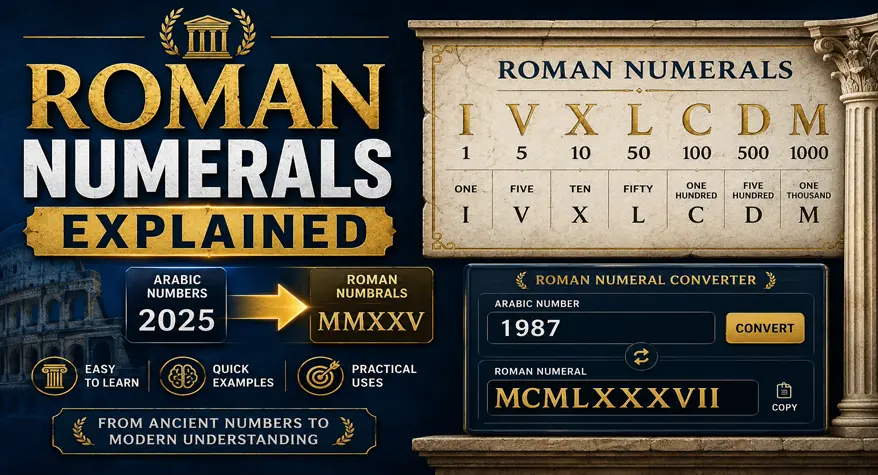
Roman numerals are still used in day-to-day life, on clock faces, chapters of books, dates for events, and even the figure outlines for classes. If you want a quick way to convert numbers, then a Roman numeral converter can work out all the values for you. You get a quick result without having to check each rule yourself. This is ideal if you need to convert higher figures or reuse the same values many times. It will also help you avoid common mistakes, such as the order of the symbols or missing a rule of subtraction. For students, authors, and others writing or working with number text, this makes the task much easier. Instead of guesswork, you can check the answer in a matter of seconds.
What Roman numerals are
Roman numerals are a number system built from letters of the Latin alphabet. The main symbols are I, V, X, L, C, D, and M, and each one stands for a fixed value.
This system is old, but it is still useful because it appears in many formal and historical contexts. People often use it for outlines, monarch names, movie sequels, and important dates.
Basic value chart
- I = 1
- V = 5
- X = 10
- L = 50
- C = 100
- D = 500
- M = 1000
Once you know these seven symbols, the rest becomes easier to understand. A number to Roman Numeral Converter is helpful when you want a fast reference without checking each rule by hand.
Works of the Roman Numerical System
To represent a number, you write a sequence of Roman numerals in an established order. Usually, the values are added together in order from left to right. On the other hand, if the smaller value precedes the larger value, this indicates that you subtract instead of add.
For example:
- VI = 6, because 5 + 1
- XII = 12, because 10 + 1 + 1
- IV = 4, because 5 – 1
- IX = 9, because 10 – 1
The rule is simple once you see it in practice. A Roman to number converter can make this process easier while you are learning the pattern.
Addition rule
When a smaller value comes after a larger one, you add them. This is the most common format and is easy to read.
Examples:
- VIII = 8
- LX = 60
- CX = 110
If you are just starting, focus on this pattern first. It will help you read most Roman numerals correctly before moving to the subtraction cases.
Subtraction rule
When a smaller value comes before a larger one, it is subtracted. This rule is used only in specific cases.
Common subtraction pairs include:
- IV = 4
- IX = 9
- XL = 40
- XC = 90
- CD = 400
- CM = 900
This rule exists to keep numerals shorter and cleaner. It is one of the main reasons people make mistakes when they try to convert numbers to Roman numerals manually.
Roman numeral chart
A simple chart makes conversion faster, especially when you need to check common values quickly. This is also where a Roman numeral calculator can help during repeated work.
Basic chart
- 1 = I
- 2 = II
- 3 = III
- 4 = IV
- 5 = V
- 6 = VI
- 7 = VII
- 8 = VIII
- 9 = IX
- 10 = X
- 20 = XX
- 30 = XXX
- 40 = XL
- 50 = L
- 90 = XC
- 100 = C
- 500 = D
- 1000 = M
Common examples
- 14 = XIV
- 19 = XIX
- 24 = XXIV
- 58 = LVIII
- 99 = XCIX
- 202 = CCII
- 2024 = MMXXIV
If you need to work with larger sets of values, using a free Roman Numeral Converter can be faster than checking each one manually. It also helps you avoid skipping symbols or using the wrong subtraction pair.
Rules you should remember
Roman numerals follow a few important rules that keep them consistent. Once you understand them, conversion becomes much easier.
- A symbol is usually not repeated more than three times in a row.
- V, L, and D are not repeated.
- Smaller symbols placed before larger symbols are subtracted.
- Larger symbols placed before smaller symbols are added.
- The same subtraction pattern should not be overused.
These rules are what separate correct Roman numerals from messy or outdated forms. If you want to convert numbers to Roman numerals accurately, these points matter more than memorizing random examples.
Common mistakes
Many people make the same errors when writing Roman numerals. Most of these happen because they rely on memory instead of checking the rules carefully.
Drawing with repetition; using too many repeated signs
One of the most common mistakes that I’m sure we have all seen is four of the same symbols in a row. For example, informal 4 is often written as IIII, but 4 should be written as IV.
This can also be seen with the numbers 9, 40, and 90. Rather than repeating the same symbol several times, use the correct subtractive notation.
Mixing subtraction patterns
Another mistake is that the symbols are not written in the right order. For example, IL is not correct for 49. It should be XLIX.
What causes people to make these errors is when they try to guess how the sentence is structured rather than using and following the rules of the conventions. A brief guide to refer to quickly will aid you in this.
Forgetting symbol limits
Some symbols are not meant to repeat. V, L, and D should not be doubled or tripled.
For example, VV is incorrect for 10, and LL is incorrect for 100. These should be written as X and C instead.
Ignoring standard form
Some numbers can be written in older or informal styles, but they are not the best choice for modern use. Standard Roman numerals are cleaner and easier to read.
If you are publishing content, building a form, or preparing educational material, always use the standard version. That keeps your work consistent and easier to understand.
Manual vs tool-based conversion
Manual conversion is effective when the numbers are small and patterns are simple. It is also helpful for the learner to understand the workings.
However, when the numbers get larger, or if you are trying to check many values quickly, manual conversion can become much slower. This is where a converter utility can be more useful.
A tool-based approach saves time, minimizes human errors, and provides consistent output. This approach can be used for students, writers, developers, and instances where an endless number of checks are needed.
For people who use online tools on a regular basis, a Random Number Generator can greatly enhance speed and accuracy. The main benefit of the Random Number Generator is that it instantly makes random numbers, saving time and hassle.
When a converter helps most
A Roman numeral converter is most useful when accuracy matters and the input changes often. It is also valuable when you need a fast answer and do not want to recalculate every time.
You may find it useful for:
- School work and practice exercises.
- Blog posts and educational content.
- UI testing and content formatting.
- Quick checks for dates, chapters, or labels.
If you often work with different number styles, a number to Roman numeral converter can speed up your workflow. It is one of those small tools that saves a surprising amount of time over the course of a project.
Practical conversion examples
The best way to learn Roman numerals is to see several examples side by side. Once the pattern is clear, conversion becomes much easier.
- 7 = VII
- 11 = XI
- 16 = XVI
- 29 = XXIX
- 44 = XLIV
- 68 = LXVIII
- 73 = LXXIII
- 145 = CXLV
- 399 = CCCXCIX
- 2026 = MMXXVI
Notice how the structure changes with the size of the number. Smaller numbers are simple, while larger numbers combine several rules in one value.
How to avoid mistakes
The easiest way to avoid mistakes is to slow down and check the value group by group. Start with the largest number first, then move to the smaller ones.
A few useful habits can help:
- Learn the subtraction pairs first.
- Check repeated symbols before finalizing.
- Keep a simple chart nearby.
- Use a converter when working with many numbers.
- Review the output for standard form.
These small steps can save a lot of time later. They also improve accuracy if you are creating content, teaching, or validating user input.
Why this topic still matters
Roman numerals are not just a historical topic. They still show up in modern layouts, content systems, and educational settings.
That is why understanding the rules matters even if you use a tool. A Roman to number converter is helpful, but it works best when you already know what the result should look like.
When you combine basic knowledge with a reliable converter, you get the fastest and cleanest workflow. That balance is especially useful for people who need both speed and accuracy.
Useful related tools
If you work with numeric content regularly, related converters can make your process smoother. For example, the Fraction to Decimal Converter can help when you need to handle mixed number formats quickly.
Alternatively, a Roman numeral calculator would be useful if you wish to convert the number directly without following the individual rules. They are particularly useful for writers, students, and developers who have to work with numbers in different formats.
Final thoughts
Roman numerals are easy once you learn the basic rules, the basic subtraction pairs, and the maximum limits of most symbols. A number to Roman numeral converter makes the process of doing this quicker, and a table of the ones makes it easier to see why the results are as they are.
If you are studying, practicing, or working on a project that uses Roman numerals, then keep the rules handy and remember the mistakes. A good Roman numeral converter can help you save hours and get it right every time!
Frequently Asked Questions
1. How do I convert a number to Roman numerals?
Arranging a number into Roman numerals adds up to the largest value that you have for the number and proceeds from the largest to the smallest value. When the smaller value is placed after a larger one, use addition; when it appears before, use subtraction. To make it quick and easy, most people use a number to roman numeral converter instead of doing each step.
2. What is the correct Roman numeral for 4, 9, 40, and 90?
Standard forms: IV is 4, IX is 9, XL is 40, and XC is 90. These forms employ the rule of subtraction; they can be thought of as a small symbol before a larger symbol that means you need to subtract. These forms are important as they are the correct standard modern style.
3. Why is IIII sometimes used instead of IV?
IIII is used on some antique clocks or in ornamental work, but here 4 is correctly written as IV. X is larger than V, so the subtraction rule applies, and IV is the correct way to write 4. IV is used for almost all writing, education, and on computers.
4. Can Roman numerals be used for large numbers?
Yes, very large numbers are possible (although the formatting becomes more complex). The standard forms are enough for the most popular values in books, dates, and labels; the Roman numeral calculator is useful when working with larger values to stop you from making formatting mistakes.
5. Is there an easy way to check Roman numeral answers?
Yes. I think the easiest option is to test your answer against a good chart or a free Roman numeral converter. This allows you to check whether the structure, repetition, and subtraction rules are correct. It is particularly helpful if you are testing a sequence of values in a row.