
Indian Number System vs. International Number System: Which One Should You Use?
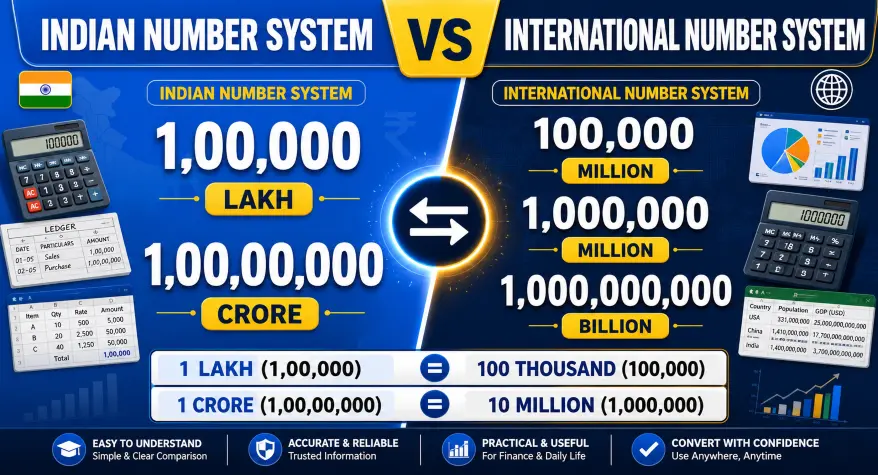
Knowing how numbers are written and spoken is more than just knowing, particularly if you deal in data, finance, invoices, spreadsheets, etc. There is a well-known confusion between the Indian number system vs international number system, where a million can be called a lakh! Even professionals of many years mistake big numbers.
Whether you work in MS Excel with reports, own a business with invoices, or work in a finance team handling huge transactions, knowing the difference between Indian and international number system can be of great help and can save your time and money.
What Is the Indian Number System?
The Indian Number System is a numbering system used in the Indian subcontinent. This system is also known as the Hindu-Arabic or Western numbering system. This system is used widely throughout the Indian subcontinent.
The Indian number system is used across India and neighbouring countries. It uses distinct place value names such as lakh and crore and differs from the million and billion system.
Key Features
- Numbers are grouped differently after the first three digits.
- Uses terms like:
- Thousand (1,000)
- Lakh (1,00,000)
- Crore (1,00,00,000)
- Comma placement follows a 3-2-2 pattern.
Example
- 10,00,000 = Ten lakh
- 1,00,00,000 = One crore
This format is commonly used in Indian financial statements, salary structures, and government data.
What Is the International Number System?
The international number system is used globally, including in the US, UK, and most business environments worldwide. It follows a more uniform grouping structure.
Key Features
- Numbers are grouped in sets of three digits.
- Uses standard terms like:
- Thousand (1,000)
- Million (1,000,000)
- Billion (1,000,000,000)
- Comma placement follows a 3-3-3 pattern.
Example
- 1,000,000 = One million
- 1,000,000,000 = One billion
This system is widely used in global trade, financial reporting, and software systems.
Difference Between Indian and International Number Systems
Understanding the difference between Indian and international number system is essential when working across regions or handling global data.
Key Differences
| Feature | Indian System | International System |
|---|---|---|
| Comma Placement | 1,00,00,000 | 10,000,000 |
| Terminology | Lakh, Crore | Million, Billion |
| Grouping Style | 3-2-2 pattern | 3-3-3 pattern |
| Usage Context | Domestic finance | Global trade |
Quick Comparison Example
- 1 crore = 10 million
- 1 billion = 100 crore
This conversion is especially important in financial reporting and global communication.
Indian Numeral System Place Value Chart
To clearly understand how numbers are structured, here’s a simplified explanation of the Indian numeral system place value chart.
Place Values
| Place Value | Numeric Value |
|---|---|
| Ones | 1 |
| Tens | 10 |
| Hundreds | 100 |
| Thousands | 1,000 |
| Ten Thousands | 10,000 |
| Lakhs | 1,00,000 |
| Ten Lakhs | 10,00,000 |
| Crores | 1,00,00,000 |
Example
Number: 5,43,21,789
Breakdown:
- 5 crore
- 43 lakh
- 21 thousand
- 789
This structure is essential for reading and writing numbers correctly in Indian contexts.
How to Write Numbers in the Indian System
If you’re used to the international format, converting numbers into the Indian system can feel confusing at first. Learning how to write numbers in Indian system is crucial for accurate communication.
Step-by-Step Method
- Start from the rightmost digit.
- Keep the first three digits together.
- After that, group digits in pairs of two.
- Insert commas accordingly.
Example
| Number | International | Indian |
|---|---|---|
| 12345678 | 12,345,678 | 1,23,45,678 |
| 987654321 | 987,654,321 | 98,76,54,321 |
| 1000000 | 1,000,000 | 10,00,000 |
For quick and error-free conversions, you can use a reliable number to word generator to instantly convert and format numbers into the correct system.
Why the Confusion Happens
Even professionals often mix up these systems, especially when working with international clients or tools like Excel.
Common Reasons
- Lack of standardization across countries
- Software defaults (Excel often uses international format)
- Similar-looking numbers with different meanings
- Manual formatting errors
Real-World Example
Imagine entering 10,00,000 in a report meant for international stakeholders. They may interpret it as ten thousand instead of one million, leading to serious misunderstandings.
Common Mistakes and How to Avoid Them
Mistakes in number formatting can lead to financial discrepancies, reporting errors, and confusion.
Frequent Errors
- Misplacing commas
- Using lakh/crore in international documents
- Incorrect conversions between crore and billion
- Manual typing errors in large numbers
How to Avoid Them
- Always confirm which system is required
- Use automated tools instead of manual conversion
- Double-check large numbers in reports
- Standardize formats within your organization
When handling large datasets, especially in invoicing or reporting, tools can help format numbers consistently and reduce manual errors.
Manual vs Tool-Based Number Formatting
When working with large numbers regularly, choosing between manual formatting and automated tools makes a big difference.
Manual Approach
- Time-consuming
- Prone to human error
- Requires a strong understanding of both systems
Tool-Based Approach
- Fast and accurate
- Eliminates formatting confusion
- Ideal for bulk data processing
| Aspect | Manual | Tool-Based |
|---|---|---|
| Speed | Slow | Fast |
| Accuracy | Prone to errors | Highly accurate |
| Effort | High | Low |
| Best For | Small datasets | Large datasets |
For example, instead of manually converting values in Excel, using a number to word generator ensures that both numeric and word formats are correct in seconds.
Time Savings and Accuracy Benefits
Efficiency matters, especially in business and finance environments.
Benefits of Using Tools
- Reduces formatting time by up to 80%
- Ensures consistency across documents
- Minimizes costly mistakes
- Improves the readability of financial reports
Practical Scenario
A finance team generating monthly reports with hundreds of figures can save hours by automating number formatting instead of checking each entry manually.
Lakh Crore to Million Billion Conversion
One of the most searched topics is how to convert between Indian and international units. Understanding lakh crore to million billion conversion is essential for global business.
Quick Conversions
| Indian Unit | Value | Intl. Equivalent |
|---|---|---|
| 1 lakh | 100,000 | 0.1 million |
| 10 lakh | 1,000,000 | 1 million |
| 1 crore | 10,000,000 | 10 million |
| 100 crore | 1,000,000,000 | 1 billion |
Example
- 500 crore = 5 billion
- 2 billion = 200 crore
Understanding these conversions is crucial for global business communication and financial reporting.
Which System Should You Use?
The choice depends on your audience and use case.
Use Indian Number System When
- Working with Indian clients or businesses
- Preparing local financial reports
- Creating content for Indian audiences
Use International Number System When
- Dealing with global clients
- Using software tools like Excel or ERP systems
- Publishing reports for international stakeholders
Best Practice
Many businesses use both systems depending on context, but consistency within a document is critical.
Practical Use Cases Across Professions
For Excel Users
- Use international format for formulas and compatibility
- Convert to Indian format for presentation if needed
For Business Owners
- Use the Indian format for local invoices
- Use international format for exports and global communication
For Accountants and Finance Teams
- Maintain dual-format reports when required
- Use tools to avoid manual conversion errors
Why Using the Right Tool Matters
Manually switching between number systems can slow down workflows and introduce errors.
A smart approach is to use a reliable number conversion tool, which not only converts numbers into words but also ensures correct formatting for both Indian and international systems.
This is especially helpful when generating invoices, financial summaries, or legal documents where accuracy is critical.
Frequently Asked Questions
1. Why does India use lakh and crore instead of million?
India uses a traditional number system in which large numbers are expressed in terms of “lakh” and “crore.” This Indian system has been used for many centuries and fits well into the local counting system in the financial world, the business world, the educational system, and the bureaucracy. It allows large numbers to be expressed in a simple way for the local population.
2. How many crores is 1 billion?
1 billion equals 100 crore. This conversion is important when comparing international financial data with Indian figures. For example, if a company reports revenue of 2 billion, it means 200 crore in the Indian number system.
3. What is the difference between lakh and million?
A lakh equals 100,000, while a million equals 1,000,000. In simple terms, 10 lakh make 1 million. The difference lies in both value and usage, as lakh is used in India, while million is part of the international number system.
4. How to write numbers in Indian system correctly?
For numbers in Indian format, a comma should be placed after the first three digits to the right, then after every two digits. For example, 12345678 will be written as 1,23,45,678. Employing a number to word generator program can be helpful and time-saving.
5. Why is the international number system used globally?
The international system is a universal way of writing numbers for ease of worldwide trade, communication, and information processing. It groups the numbers systematically, which enhances clarity and enables better digital processing.
Final Thoughts
The decision of selecting among Indian and foreign systems is not whether you are going to use one or the other; it is purely about selecting the right format for the right audience. So learn the key differences, use available online tools, and you will be able to save confusion, achieve consistency, and work smart with numbers of any size.