
How to Write Large Numbers in Words Without Mistakes
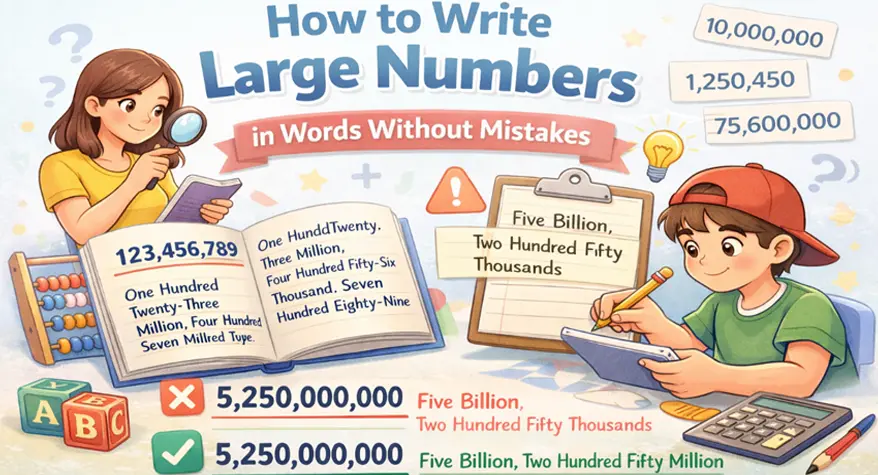
Writing numbers in words can be considered easy, though as numbers keep increasing, one tends to lose track. It is necessary to know how to write large numbers in words correctly, whether you are filling out a cheque, preparing a document, or you are learning mathematics. The guide is meant to make the process easier, help you learn patterns, and, above all, help you avoid mistakes when writing numbers. We will divide it into simple, practical steps.
Understanding How to Write Large Numbers in Words
Writing in words involves translating numbers into the appropriate word form, using place value and structured patterns. This is not merely an academic skill; it is also important in the real world, in areas such as banking, legal paperwork, and articulation.
Why Learning This Skill Is Important in Everyday Use
Knowledge of this skill will ensure there is no misinterpretation in vital documents. Writing cheques and completing official forms are areas where writing numbers correctly helps avoid financial and legal mistakes. It also enhances the quality of communication, especially in formal writing.
Common Mistakes People Make While Writing Numbers in Words
Many people make avoidable errors when dealing with large numbers. Common issues include:
- Ignoring place value structure
- Misusing “and” in number writing
- Forgetting hyphens in compound numbers
- Mixing formats (million vs lakh system)
Basic Rules for Writing Numbers Correctly in English
You should learn some simple rules to master writing numbers correctly in English. These rules serve as the basis of the translation of any number, big or small, into words correctly.
What Is the Basic Rule for Reading and Writing Numbers?
The basic principle is the division of numbers into groups (ones, thousands, millions) and reading them in order (left to right). Each group is represented in words, followed by the name of its place value. This is a systematic procedure that eliminates misunderstanding and inaccuracy.
Difference Between Digits and Number Names
Understanding this difference is key to converting numbers properly.
| Digits | Number Names |
| 5 | Five |
| 25 | Twenty-five |
| 100 | One hundred |
| 1,000 | One thousand |
Numbers are represented by numbers, whereas their words are called number names. The main part of this skill is to be able to convert between them.
Step-by-Step Process to Convert Numbers into Words
If you are asking how to convert numbers to words easily, the task is made easier when broken down into steps. This can be accomplished by dividing the number into smaller parts rather than attempting to read the entire amount.
- Break the number into groups of three digits
- Identify each group’s place value (thousand, million, etc.)
- Convert each group into words
- Combine them in order from left to right
For example:
1,245,678 → One million, two hundred forty-five thousand, six hundred seventy-eight
Writing Small to Large Numbers Without Confusion
To create confidence, begin with smaller numbers and gradually increase them. This gradual learning process clarifies and minimizes mistakes when learning complex numbers.
How to Write Numbers Between 20 and 100 (Pattern Explained)
Numbers between 21 and 99 follow a consistent pattern using hyphens.
Example:
- 21 → Twenty-one
- 45 → Forty-five
- 99 → Ninety-nine
How to Write a Three-Digit Number in Words
Three-digit numbers follow a simple format:
- Write the hundreds place
- Add the remaining two-digit number
Example:
582 → Five hundred eighty-two
How to Write Numbers in Thousands, Lakhs, and Millions
Larger numbers depend on the system used:
- International: Thousand, Million, Billion
- Indian: Thousand, Lakh, Crore
Example:
1,000,000 → One million
10,00,000 → Ten lakh
Formatting Rules That Help Avoid Mistakes in Number Writing
Formatting is of paramount importance when you avoid mistakes in number writing. The words may be right, but not in the right format, which can cause confusion.
- Use hyphens for compound numbers (twenty-one)
- Avoid unnecessary use of “and” in whole numbers
- Maintain consistency in number systems
- Use commas correctly to separate place values
When Should Numbers Be Written as Words Instead of Digits?
In situations where clarity and formality are the most important, numbers must be expressed in words. This entails financial, academic, and legal worlds.
- Writing cheques (to prevent fraud)
- Legal agreements and papers.
- Academic writing and essays
- Formal communication
Digits are preferred in data-heavy or technical contexts, but words ensure clarity in sensitive scenarios.
Writing Very Large and Scientific Numbers in Words
Numbers longer than millions and billions may prove difficult to write down in words, but the principles are still the same. Even complex numbers can be written clearly with the help of the place-value structure and the grouping of digits in the correct order. Knowledge of how to write large numbers in words at this level makes one accurate in financial, academic, and technical situations.
What Size Numbers Can Be Converted into Words?
Technically, there is no limit to the number of place value systems whose numbers may be converted to words, provided that the place value systems are used correctly. Readability and usability, however, are important factors as the size increases.
- Numbers from thousands to trillions can be written easily using standard place values
- Extremely large numbers follow extended scales like quadrillion, quintillion, and beyond
- The process always involves grouping digits into sets of three
- Larger numbers may become difficult to read if written fully in words
Can Scientific or Extremely Large Numbers Be Written in Words?
Surely even scientific or very large numbers can be written in words, but they are simplified frequently to be useful. Rather than writing a long series of letters, there are established conventions of names.
- 1,000,000 → One million
- 1,000,000,000 → One billion
- Scientific values like 10⁶ can be written as “ten to the power of six.”
- In most cases, simplified expressions improve readability and understanding
Limitations of Manual Writing vs Tools
Although manual writing provides insight, it also introduces inefficiency and error-proneness with very large numbers. At this point, tools are beneficial in practice.
- Writing by hand increases the likelihood of place-value errors.
- Long numbers can lead to spelling and formatting mistakes
- Complex values are more time-consuming.
- Digital tools guarantee rapid, more precise conversion.
- Helping prevent errors in writing numbers, tools are used in important documents such as cheques and reports.
Large Numbers in Words Guide – Quick Tips for Accuracy
It will be so much easier to write the large numbers in words as long as you adhere to a systematic method and concentrate on accuracy. With a few tricks, errors can be used to minimize errors, and confidence can be maximized in working with complex numbers.
- The conversion should start by checking the place value.
- Break large numbers into smaller groups (thousands, millions, etc.)
- Follow consistent formatting rules (hyphens, commas, spacing)
- Use of unnecessary ‘and’ in whole numbers should be avoided.
- Double-check the spelling of number names carefully
- Stick to one numbering system (Indian or International)
- Read the last number and check whether it is correct.
Conclusion – Master Writing Numbers in Words with Confidence
Learning to write large numbers in words is not all about the rules, but rather about practice, simplicity, and how to avoid the most frequent errors. With knowledge of place value, orderly sequences, and the use of the rules of formatting, you will be able to compute even the most complicated numbers with ease.
To simplify this process even more and eliminate errors, you may resort to Number-to-Word, which is not a complicated but a trusted tool that allows you to convert numbers into correct word forms in a few seconds. It saves time while offering accuracy, whether you are working on documents, cheques, or learning.
Frequently Asked Questions
1. How to write large numbers in words?
Divide the number into place-value groups (thousands, millions, etc.) and translate each group into words, left to right.
2. How do you write numbers in words in English?
Write numbers in English according to place-value rules, using hyphens with tens and ones, and add scale words such as thousand or million.
3. Why is place value important when writing large numbers in words?
Place value ensures that every number is properly interpreted and written down, so that no mistakes occur when converting large numbers.
4. When should numbers be written as words instead of digits?
In formal situations, such as writing cheques, legal documents, and papers, numbers are to be written in words to prevent confusion and fraud.
5. What size numbers can be converted into words?
Standard place value systems or tools allow the conversion of almost any number or amount (from small values to billions and even larger) into words.