
Number to Words Conversion: Rules, Examples & Common Errors
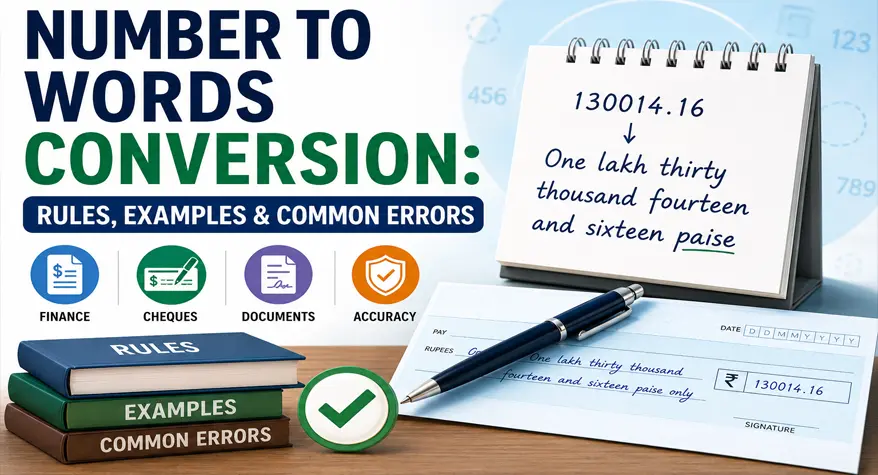
The Number to words conversion is vital in cases where precision is required, mainly in financial reports, schoolwork, and official correspondence. You may need to write a cheque by converting numbers to words, or you may need to learn how to write numbers in words; either way, it is important to follow the right rules so you do not make a huge mistake. A small error like misplacing “and” or writing “fifteen” instead of “fifty” can completely change the intended amount or value. This is especially risky when dealing with legal documents or bank transactions, where even a tiny slip can lead to delays or rejected payments. Taking a few extra seconds to double-check your number words might save you from a headache later on.
What Is Number to Words Conversion and Why It Matters
Number-to-words conversion is the process of converting numeric values into written words. This is done to restore sanity and prevent confusion, and it is common in professional and financial environments.
It proves particularly significant when it concerns money, legal documentation, or official communication, where the slightest mistake can confuse.
Where Is It Used in Real Life? (Finance, Cheques, Documents)
Number conversion plays a key role in real-world scenarios where precision is critical.
- Writing cheque amounts
- Preparing invoices and contracts
- Filling out banking or government forms
- Academic and examination purposes
How to Convert Numbers into Words Correctly
To answer the question of how to write numbers in words, you should follow a systematic approach based on place value and the correct sequence to ensure consistency, which helps avoid mistakes, particularly with large or decimal numbers.
Step-by-Step Method to Convert Numbers to Text
To convert numbers to text, one has to do the following steps:
- Break the number into place values (units, tens, hundreds, etc.)
- Convert each part into words.
- Combine them in order.
- Add currency or decimal terms if required
Example:
130014.16 → One lakh thirty thousand fourteen and sixteen paise
Essential Number to Words Rules You Must Follow
You have to use the common Number to words rules to be accurate. These conventions help in maintaining order and homogeneity in the forms. These rules are important for writing numbers in words successfully.
Rules for Writing Units, Tens, and Hundreds
Basic number writing follows structured naming patterns.
- 45 – Forty-five
- 100 – One hundred
- 215 – Two hundred fifteen
Rules for Thousands, Lakhs, and Millions
The system varies in the way large numbers are grouped.
- 1,000 is written as one thousand
- 1,00,000 is written as One lakh
- 1,000,000 is written as one million
Use of “And” in Number Writing (British vs American Style)
The application of and its dependence on the region.
- British/Indian: One hundred and twenty-three
- American: One hundred twenty-three
There should be consistency in style selection.
Capitalization and Formatting Rules
Proper formatting improves readability and professionalism.
- For clarity, insert hyphens for numbers like twenty-one
- Maintain consistent case
- Write the word in capital letters only when required
Indian vs International Number System Explained Clearly
Both the Indian and International Number Systems are important to understand to do correct number-to-words conversion, particularly in global or financial contexts.
| Number | Indian System | International System |
| 1,00,000 | One lakh | One hundred thousand |
| 10,00,000 | Ten lakh | One million |
| 1,00,00,000 | One crore | Ten million |
Key Differences with Examples
The Indian system uses lakhs and crores, while the international system uses millions and billions.
Example:
30,000,000
- Indian: Three crore
- International: Thirty million
How to Write Numbers in Words for Cheques and Financial Documents
One needs to be able to write the numbers in words when the cheques and other financial documents are needed, since this method is accurate, clear, and legal. It allows avoiding tampering, minimizes misunderstanding, and makes sure the numeric value is equal to the written value. Understanding the proper way to write numbers in words is also particularly valuable in the area of banking, contracts, and official transactions, where even minor mistakes can cause major problems.
Method to Write Numbers in Words for Financial Documents:
- Start with the full numeric amount
Carefully read the number and identify both the whole number and decimal part (if any). - change the entire number into words.
Break it into place values (thousands, lakhs, millions) and write it in words. - Add the currency name clearly
Put terms such as rupees, dollars, or the currency one is looking at after the number. - Write the decimal part separately.
Talk about decimals as paise or cents or give them in fraction form (e.g., 62/100). - Use proper formatting and spacing.
No additional gaps should be placed, and the words should be written continuously without ambiguity. - Draw a line after the written amount (in cheques)
This will not allow any person to append additional words or change the amount. - Match words with numbers exactly.
It is always important to make sure that what is written matches the figure precisely.
Following this method ensures your number to words conversion is accurate, secure, and suitable for all financial uses.
Why Writing Amounts in Words Prevents Errors and Fraud
Writing in words brings in protection and accuracy.
- Prevents number manipulation
- Reduces confusion in transactions
- Ensures legal accuracy
Common Mistakes in Number to Words Conversion (And How to Avoid Them)
The common mistakes in number to words in number-to-word conversions cause problems for many users, particularly with large numbers or decimals. It is possible to avoid such errors by being accurate and professional or taking care of the following points:
- Incorrect comma placement
- Misuse of “and.”
- Inaccuracies in representation by decimals.
- Blending indigenous and global systems.
- Mistakes in spelling are numerous.
Always double-check your output or use reliable tools for verification.
Is Number to Words Conversion Accurate for Financial Documents?
Yes, converting numbers to words is usually accurate for financial documents when done with care, but it must be checked every time. Although tools can be useful for converting numbers to text in a relatively short time, errors in formatting or in the system might occur. In the case of cheques and legal documents, double-checking will make the documents clear, avert fraud, and eliminate expensive errors in high-value transactions.
When You Can Rely on Converters
Online tools are useful for:
- Quick conversions
- Standard formatting
- Large number calculations
Situations Where Double-Checking Is Required
Manual verification is important when:
- Writing cheques
- Preparing legal documents
- Handling high-value transactions
Best Practices for Error-Free Financial Writing
To ensure accuracy:
- Cross-check converted values
- Follow consistent rules
- Avoid mixing number systems
- Use trusted tools
Final Thoughts: Mastering Number to Words Conversion Easily
Acquisition of number-to-words conversion is related to the rules, their correct application, and the prevention of mistakes in real life. Learning to write numbers in words to discover common number-to-word errors is critical in both personal and professional life.
Use the Number-to-Word converter today to convert numbers into text with high accuracy, and handle even complex numbers with confidence.
Frequently Asked Questions
1. How to convert numbers into words correctly?
Decompose the number into place values, assign words to each part, and then add them up in the correct order.
2. What are the rules for converting numbers into words?
Sequence of place value, use of “and”, proper grouping (thousands/lakhs/millions), and rules of formatting.
3. How do you write numbers in words for a cheque?
Write the amount in full words with currency (rupees/dollars) and include decimals as paise or cents for accuracy.
4. How is the decimal part of a number written in words?
The decimal fraction is then expressed distinctly, either using the term point or currency fractions (e.g., paise or cents) following the whole number.
5. What is the difference between the Indian and the International number systems?
Lakhs and crores are available in the Indian system, whereas thousands, millions, and billions are available in the international system for grouping numbers.