
Common Invoice and Purchase Order Errors Procurement Officers Should Avoid
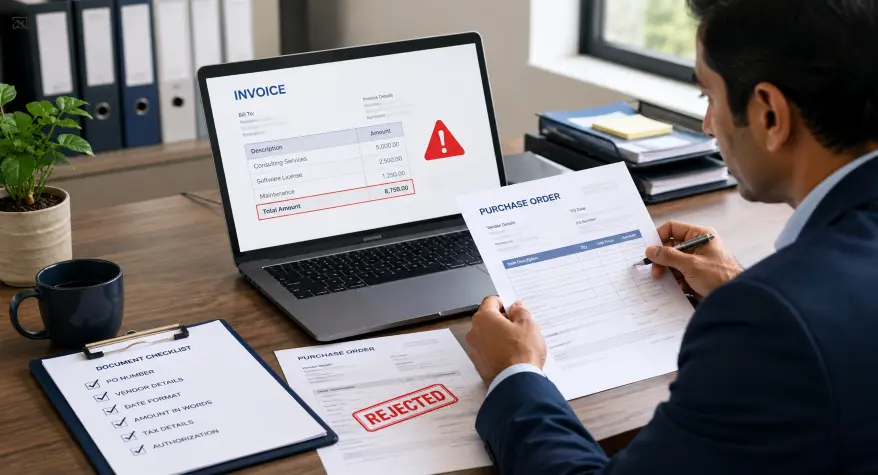
Every procurement team deals with invoices, purchase orders, delivery documents, and approval records. Small errors in these documents can delay invoice processing, create supplier queries, or require additional approval and reconciliation.
Common problems include incorrect supplier details, missing purchase order references, quantity or price differences, unclear dates, incorrect currency, and mismatched amounts.
This guide explains the most common invoice and purchase order errors and provides a practical checklist that procurement officers can use before documents are submitted for approval or payment.
Why Invoice and PO Errors Cause Delays
An invoice or purchase order error can create additional work for procurement, finance, accounts payable, and suppliers.
For example, an invoice with the wrong purchase order number may need to be returned to the supplier for correction. A quantity or price mismatch may require the procurement officer to compare the invoice with the purchase order and receipt before payment can proceed.
Common consequences include:
- Invoice processing delays
- Additional supplier communication
- Manual corrections and re-entry
- Reconciliation issues
- Delayed approvals
- Additional audit or compliance review where applicable
The exact approval and payment requirements depend on the organization’s policies, contracts, and applicable regulations.
Invoice Errors That Derail the Payment Process
Invoice errors are the most common source of procurement delays. Here are the types that come up most frequently:
Missing or Incorrect Invoice Numbers
An invoice should have a clear reference number that allows the buyer and supplier to identify and track the transaction.
Common problems include:
- Missing invoice numbers
- Duplicate invoice numbers
- Incorrect invoice references
- Inconsistent numbering between documents
These issues can make invoice matching and recordkeeping more difficult. Procurement and accounts payable teams should check the invoice reference against the supplier record and purchase order where applicable.
Wrong Vendor Details
Supplier information should match the approved vendor record used by the organization.
Check details such as:
- Legal or registered supplier name
- Supplier or vendor code
- Billing address
- Tax registration details where applicable
- Bank details, where relevant to the organization’s verification process
Differences between the invoice and the supplier master record may require clarification before the invoice can be processed.
Always verify supplier information against the organization’s approved vendor records rather than relying only on previous invoices.
Incorrect VAT or Tax Amounts
Tax calculations should match the applicable tax rules and the transaction details.
When reviewing an invoice, check:
- Taxable amount
- Applicable tax rate
- Tax amount
- Exempt or zero-rated items where applicable
- Total invoice amount
- Required tax registration information
For cross-border transactions, the applicable tax treatment can depend on the countries involved, the type of supply, and the organization’s tax obligations. Procurement teams should follow their finance or tax department’s guidance rather than assuming that the supplier’s tax treatment is automatically correct.
Tax requirements can change, so country-specific guidance should be verified against the relevant tax authority.
Amount in Numbers Not Matching Amount in Words
When an invoice or financial document displays an amount in both figures and words, the two representations should match.
For example:
Numeric amount: 25,500
Amount in words: Twenty-Five Thousand Five Hundred
An error could occur if the numeric amount is 25,500 but the written amount says Twenty-Five Thousand.
Before submitting a document, compare the numeric amount with the written amount and check the currency and decimal or subunit amount where applicable.
You can use our Number to Words Converter to generate or check the written form of an amount.
Purchase Order Errors That Lead to Vendor Disputes
Purchase orders are the backbone of procurement control. A purchase order error creates misalignment between what was agreed and what gets delivered or invoiced — and that misalignment is expensive to resolve.
Missing Purchase Order Numbers on Invoices
Where the organization’s process requires a purchase order, the supplier invoice should reference the correct PO number.
A missing or incorrect PO reference can make it difficult to match the invoice with the approved order and may result in additional verification.
Before sending a purchase order to a supplier, ensure the PO number is clearly visible. When invoices are received, check that the referenced PO exists and belongs to the correct supplier and transaction.
Quantity or Price Discrepancies
A difference between the purchase order, goods receipt, and supplier invoice may require investigation before payment.
For example:
| Item | Purchase Order | Invoice |
|---|---|---|
| Quantity | 100 | 110 |
| Unit price | $25 | $25 |
| Total | $2,500 | $2,750 |
This creates a difference that should be resolved before the invoice is approved.
Where a three-way matching process is used, procurement or accounts payable teams compare the purchase order, receipt, and invoice to identify quantity, price, or other discrepancies.
Before issuing a PO, confirm quantities, prices, discounts, delivery terms, and other agreed commercial conditions.
Wrong Currency or Currency Formatting
Currency should be clearly identified on both the purchase order and invoice.
For example, an invoice should not create uncertainty about whether 1,250 represents QAR, USD, EUR, or another currency.
Check:
- Currency code or symbol
- Currency stated on the purchase order
- Currency used on the invoice
- Exchange-rate information where applicable
- Decimal and thousands separators
Regional number conventions can also cause confusion. For example, 1,250.75 and 1.250,75 use different separator conventions.
When working with international suppliers, follow the organization’s required currency and number-formatting conventions and make the currency explicit.
PO Review Checks Before Issuing an Order
Before issuing a purchase order, check:
- Required internal approval has been obtained.
- Supplier details match the approved vendor record.
- Item descriptions, quantities, and prices are correct.
- Currency is clearly stated.
- Delivery requirements are clear.
- Payment terms match the agreed terms or contract.
- Warranty or service conditions are included where applicable.
- The PO number is correctly generated and recorded.
- Any required tax information is included.
The exact approval process depends on the organization’s procurement policy and delegation of authority.
Date Format Mistakes in Procurement Documents
Date formatting is one of those procurement mistakes that looks minor until it causes a serious problem.
DD/MM/YYYY vs. MM/DD/YYYY Confusion
Different countries and organizations use different date conventions. A date such as 01/03/2026 can therefore be ambiguous because it may be interpreted as 1 March or January 3, depending on the convention being used.
For international procurement documents, an unambiguous format can reduce this risk. For example:
01 March 2026
or
2026-03-01
Use the date format required by the organization, contract, software system, or applicable standard.
For converting dates into written form, you can use our Date to Words Converter.
Incorrect Payment Term Dates
Payment terms should be checked against the invoice date, purchase order, contract, and applicable payment conditions.
For example, if an organization agrees to Net 30, the relevant due date should be calculated according to the agreed terms and the organization’s accounting process.
Errors in invoice dates or payment terms can create disagreements about when payment is due. Procurement and accounts payable teams should verify the dates before approving the invoice.
Number Formatting Errors in Financial Documents
Beyond the number-to-words requirement, financial document formatting mistakes come in several forms.
Indian and International Number Formatting
International suppliers may use different digit-grouping conventions.
For example:
Indian format: 2,50,000
International format: 250,000
Both represent the same numerical value, but the grouping is different.
This can become confusing when procurement teams work with suppliers or systems using different regional conventions. Always follow the number format required by the organization’s accounting or procurement system and make the convention clear when exchanging documents internationally.
For large sets of numerical values, a Number Formatter can help apply consistent digit grouping and number formatting.
Decimal and Thousand Separator Confusion
Different regional conventions use different symbols for decimal and thousands separators.
For example:
1,250.75
uses a comma for thousands and a period for decimals, while:
1.250,75
uses a period for thousands and a comma for decimals.
When documents are exchanged internationally, confirm the expected number format and make the currency explicit. This is particularly important when invoices are entered manually into systems that may use different regional settings.
For more examples of regional number formatting conventions, see our guide to formatting large numbers.
Procurement Document Review Checklist
Before submitting or approving an invoice or purchase order, check:
- Invoice number is present and correctly recorded.
- Purchase order number is correct where required.
- Supplier name and vendor details match the approved record.
- Invoice date is clear and correct.
- Currency is clearly stated.
- Quantities and unit prices match the purchase order where applicable.
- Amount in figures matches the amount in words where both are required.
- Tax calculations and required tax information have been checked.
- Payment terms match the applicable agreement.
- Delivery terms are correct.
- Required approvals or authorizations are complete.
- Supporting documents are attached where required.
A short review before submission can reduce avoidable clarification and rework.
Best Practices for GCC Procurement Teams
Standardize document templates
Use consistent invoice and purchase order templates with clearly identified mandatory fields. This makes missing information easier to detect before documents enter the approval process.
Communicate requirements to suppliers
Give suppliers clear instructions about required PO references, invoice fields, supporting documents, currency, and submission procedures.
Use a pre-submission review
A short review before an invoice or PO is submitted can catch incorrect quantities, prices, dates, supplier information, and references.
Keep records consistent
Use the same supplier names, vendor codes, PO references, date conventions, and currency formats across related documents.
Document exceptions
If an invoice differs from the PO because of an approved change, credit note, partial delivery, or other reason, keep the supporting documentation with the transaction.
Frequently Asked Questions
1. What are the most common invoice errors in procurement?
Common invoice errors include missing or incorrect PO references, incorrect supplier information, quantity or price differences, unclear dates, incorrect currency, duplicate invoices, and differences between amounts in figures and words where both are required.
2. Why are invoices rejected or returned for correction?
An invoice may be returned when required information is missing or does not match the purchase order, supplier record, contract, receipt, or organizational requirements. The exact reasons depend on the organization’s invoice-processing procedure.
3. What causes invoice processing delays?
Processing can be delayed by missing documentation, incorrect supplier details, PO mismatches, quantity or price differences, incorrect dates, tax issues, or missing approvals.
4. How can procurement officers reduce document errors?
Use standardized templates, verify supplier and PO information, compare invoice details with the purchase order and receipt where applicable, and complete a pre-submission checklist.
5. What should a procurement invoice include?
The required fields depend on the organization and applicable regulations. Common information includes the supplier details, invoice number, invoice date, purchase order reference where applicable, description of goods or services, quantities, prices, applicable taxes, currency, total amount, payment terms, and required supporting information.
6. What should procurement officers check before approving an invoice?
Check the supplier, invoice number, PO reference, dates, quantities, prices, currency, taxes, total amount, payment terms, supporting documents, and required approvals.