
How to Write Fractions and Decimals in Words for Cheques and Legal Documents
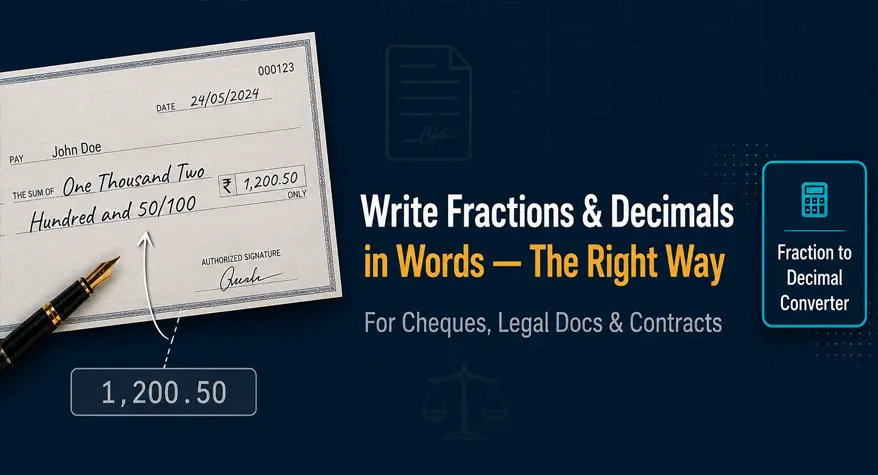
When it comes to cheques and legal writing, a typo can be costly — a cheque being rejected, a contract being disputed, a transaction being delayed. Writing out numbers in words may seem trivial, but banks and legal firms are far from accommodating on this issue.
Whether you are dealing with a simple whole number or a tricky decimal like 12.50, knowing how to write numbers in words for cheque is a practical skill that saves you from unnecessary complications.
Why Writing Numbers Correctly in Cheques and Legal Documents Matters
Banks verify cheque amounts twice — once from the numeric figure in the box and once from the words written on the line. If these two do not match, the bank has the right to return the cheque unpaid or, in some cases, process the amount written in words, which is considered legally binding in most jurisdictions.
Legal documents are treated with the same level of care. Contracts and agreements, the deed to property, invoices, and the like often have their figures fully expressed in words. Confusion here may result in a dispute, alteration or outright return.
The stakes are higher than most people realise. A missed “and” or a misplaced decimal reference can completely change what a document communicates — sometimes with serious financial consequences.
How to Write Whole Numbers in Words for Cheques
Before getting into decimals and fractions, it helps to understand the baseline — how whole numbers are written correctly.
For a cheque, you write the full number in words starting with the largest denomination. Here are a few examples:
- 500 → Five Hundred Only
- 1,250 → One Thousand Two Hundred and Fifty Only
- 10,000 → Ten Thousand Only
The word “Only” at the end is important. It signals to the bank that the amount ends there and leaves no room for additions or alterations after the fact.
Always write numbers in continuous words without large gaps. Some people draw a line through the empty space after the amount — a useful habit that prevents tampering on physical cheques.
How to Write Decimal Numbers in Words
This is where most people stumble. When the amount includes paise, cents, or any sub-unit currency, you need to express the decimal number in words separately.
The standard format is: [Main amount in words] and [decimal digits] / 100
For example:
- 12.50 → knowing how to write 12.50 in words correctly gives you: Twelve and 50/100 or Twelve Rupees and Fifty Paise Only
- 250.75 → Two Hundred Fifty and 75/100 or Two Hundred Fifty Rupees and Seventy-Five Paise Only
- 1,000.30 → One Thousand and 30/100 or One Thousand Rupees and Thirty Paise Only
When you write decimal in words, the decimal point is replaced with the word “and” — that single word separates the whole number from its fractional part. Never use “point” in formal financial or legal writing.
How to Write Fractions in Words
Fractions appear in legal documents more often than in cheques. You might encounter them in property records, partnership agreements, or measurement documents.
The rules for how to write fractions in words are straightforward:
- 1/2 → One-Half
- 1/3 → One-Third
- 2/3 → Two-Thirds
- 3/4 → Three-Quarters or Three-Fourths
- 1/4 → One-Quarter or One-Fourth
- 3/8 → Three-Eighths
The hyphen is the subject of this point of order. It is used for the majority of fractions, which simply places a hyphen between the numerator and denominator where both are written as words. This is acceptable in formal writing and, preferably, in legal writing.
When the denominator goes beyond ten, you add “-ths” to the number:
- 1/5 → One-Fifth
- 7/10 → Seven-Tenths
- 3/16 → Three-Sixteenths
If the fraction is part of a larger mixed number like 2¾, you write it as: Two and Three-Quarters.
Common Mistakes People Make When Writing Amounts in Words
Even experienced professionals make errors here. These are the most frequent ones:
Using “point” instead of “and”
Writing “Twelve point fifty” is incorrect for formal documents. The correct phrasing when you write decimal in words is “Twelve and Fifty Paise” or “Twelve and 50/100.”
Skipping the sub-unit entirely
Some people write only the main amount and ignore the decimal entirely. This can create confusion, especially if the sub-unit amount is significant. Always account for every digit.
Inconsistent capitalisation
Cheques and legal documents often use title case or all caps for the amount in words. Whatever style you choose, keep it consistent throughout the document.
Leaving space for alteration
Never leave blank spaces before or after the written amount. Draw a line through any remaining space to prevent tampering.
Writing “hundred and” incorrectly
In formal writing, “one hundred and fifty” is fine in British English, but “one hundred fifty” is fine in American English. Just know your format based on the country, the school, and the institution you are dealing with.
Manual Approach vs. Using a Tool
If you only infrequently write figures manually to a set pattern, then it is manageable, but if you have to do it every day or many times a day on cheques, invoices, contracts, or accounts, then manual conversion is slow and comes with the possibility of human error.
A dedicated conversion tool eliminates that risk entirely. For anyone regularly dealing with decimals and fractions in financial paperwork, the Fraction to Decimal Converter handles these conversions instantly — giving you the exact representation without second-guessing the format.
It is especially useful when working with recurring decimals or unusual fractions that are difficult to convert mentally, saving both time and potential errors in high-stakes documents.
How Different Countries Handle Decimal Amounts in Cheques
The format of how to write amount in words varies subtly based on the place where you are banking or filing the papers.
India: Amount is written as Rupees [amount] [sub-unit], Paise [sub-unit] Only. For e.g. Rs 1,250.50 becomes Rupees One Thousand Two Hundred Fifty and Paise Fifty Only
United States: Cents are generally written as a fraction of 100. Being familiar with how to write cheque amount with cents in the US involves writing $1,250.50 as “One Thousand Two Hundred Fifty and 50/100 Dollars.”
United Kingdom: Same as the US style, but some banks prefer the pence to be spelt out in full. GBP 1,250.50 would be displayed as “One Thousand Two Hundred and Fifty Pounds and Fifty Pence.”
Gulf countries (UAE, Qatar and Saudi Arabia): Format: “Dirhams / Riyals [amount] and Fils / Halalas [sub-unit] Only”.
Having an idea of what the local expectation is before you write an amount prevents a document from being needlessly rejected or returned.
Writing Large Amounts That Include Decimals
However, when applying it to large numbers with decimal parts, the effort involved increases as it is more difficult to keep track of where you are and to avoid miswriting a denomination. This is where being familiar with how to write decimal numbers in words using large denominations becomes crucial for property deals and commercial agreements.
Here is how to approach it step by step:
- Break the number at the decimal point
- Convert the whole number part to words using standard denomination (thousands, lakhs, millions — depending on your numbering system)
- Add “and” to bridge the whole and decimal parts
- Write the decimal portion either as a fraction of 100 or in its currency sub-unit equivalent
For example, ₹15,47,250.85 in the Indian system becomes:
“Rupees Fifteen Lakh Forty-Seven Thousand Two Hundred Fifty and Paise Eighty-Five Only”
In the international system, $1,547,250.85 would be:
“One Million Five Hundred Forty-Seven Thousand Two Hundred Fifty and 85/100 Dollars”
Breaking it into steps makes even complex amounts manageable and reduces the chance of error.
For documents that also require the date to be written out formally, the Date to Words Converter handles that quickly, making it a useful companion when preparing complete legal or banking paperwork.
Summary
Writing fractions and decimals correctly on cheques and legal documents is not difficult, provided you know the rules. These are:
- Use “and” instead of a decimal point
- Express sub-units (paise, cents, fils) in words or as a fraction of 100
- It is essential to prefix each cheque amount with the word “Only” (i.e. Only) as this confirms that figures are in words
- Write fractions in words with hyphens
- Use this kind of numbering, in the format of your country/institution
For anyone regularly converting between decimals and fractions, the Fraction to Decimal Converter takes the guesswork out of the process. Getting these details right the first time keeps your documents clean, professional, and legally sound.
Frequently Asked Questions
1. How do I write 12.50 in words for a cheque?
Never write it as “12.50.” In the US format, write it as “Twelve and 50/100,” or in the Indian format, write it as “Twelve Rupees and Fifty Paise Only.” Use “and” instead of a decimal point. Always include the sub-unit — it may seem insignificant in value, but omitting it can cause confusion or rejection at the bank.
2. What is the correct way to write a fraction in a legal document?
The standard rule is the hyphenated word form. Common fractions should be written out in full — for example, 3/4 becomes “Three-Quarters” or “Three-Fourths.” For less common fractions, add “-ths” to the denominator — for example, 3/16 becomes “Three-Sixteenths.” Always hyphenate the numerator and denominator words and avoid using numerals in formal documents.
3. Can I use “point” when writing decimal numbers in words?
Not in formal financial or legal writing. The word “point” is used in casual or spoken contexts only. In cheques and legal documents, the decimal point is expressed using the word “and” — for example, 5.25 becomes “Five and Twenty-Five Hundredths” or “Five and 25/100.”
4. Why does the bank give priority to the written amount over the numeric amount?
In most banking jurisdictions, the amount written in words is considered the legally binding figure. Numeric figures are more prone to tampering or misreading, while written words are harder to alter without it being obvious. If there is a conflict between the two, most banks default to the word amount.
5. Is the word “Only” mandatory at the end of a cheque amount?
While not universally mandatory, writing “Only” is strongly recommended and expected in most banking systems, particularly in India and Gulf countries. It acts as a stop marker, signalling that the amount ends there and prevents any additions or alterations after the fact.