
Ordinal vs. Cardinal Numbers: Differences, Examples and Usage
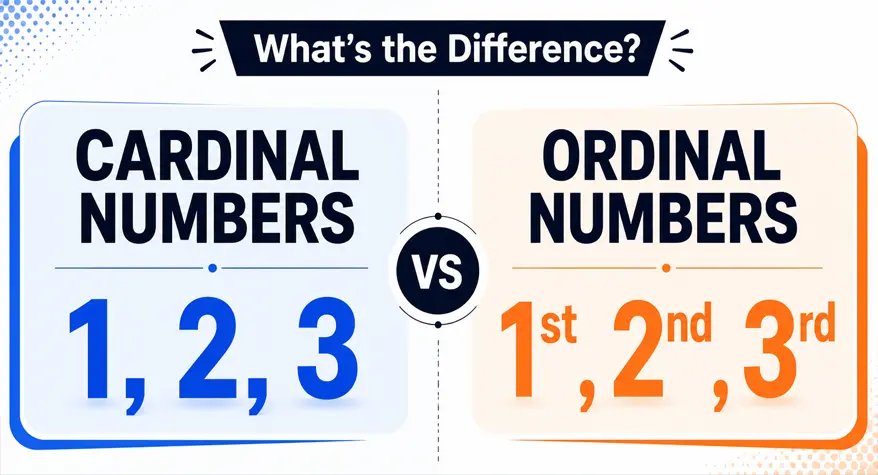
Cardinal and ordinal numbers serve different purposes in English. Cardinal numbers tell us how many, while ordinal numbers tell us the position or order of something.
For example, five students use a cardinal number because it describes quantity, while the fifth student uses an ordinal number because it describes position.
This guide explains the difference with examples covering counting, dates, rankings, addresses, measurements, grammar, and common writing mistakes.
What Are Cardinal Numbers?
Cardinal numbers tell us how many. They are used for counting quantities and expressing measurements, ages, values, and other amounts.
Examples:
- Five books
- Twenty students
- 3 kilograms
- 25 degrees
- 50 employees
Common cardinal numbers include:
one, two, three, four, five, ten, twenty, one hundred, one thousand
What Are Ordinal Numbers?
Ordinal numbers tell us where something comes in an order or sequence.
Examples:
- First place
- Second floor
- Third attempt
- Fourth chapter
- Twenty-Fifth anniversary
Common ordinal forms include:
first, second, third, fourth, fifth, tenth, twentieth, hundredth
Ordinal numbers can be written as words or numerals with suffixes:
first = 1st
second = 2nd
third = 3rd
fourth = 4th
Cardinal vs. Ordinal Numbers: The Core Difference
The easiest way to remember the difference is:
Cardinal = how many
Ordinal = position or order
| Cardinal | Ordinal | Example |
|---|---|---|
| One | First | one student / first student |
| Two | Second | two students / second student |
| Three | Third | three students / third student |
| Four | Fourth | four students / fourth student |
| Five | Fifth | five students / fifth student |
| Ten | Tenth | ten students / tenth student |
| Twenty | Twentieth | twenty students / twentieth student |
| One Hundred | Hundredth | one hundred students / hundredth student |
The key question is whether the number describes quantity or position.
Ordinal Numbers Examples 1 to 100
| Number | Ordinal | Number | Ordinal |
|---|---|---|---|
| 1 | 1st | 11 | 11th |
| 2 | 2nd | 12 | 12th |
| 3 | 3rd | 13 | 13th |
| 4 | 4th | 20 | 20th |
| 5 | 5th | 21 | 21st |
| 6 | 6th | 22 | 22nd |
| 7 | 7th | 23 | 23rd |
| 8 | 8th | 24 | 24th |
| 9 | 9th | 30 | 30th |
| 10 | 10th | 31 | 31st |
| 40 | 40th | 50 | 50th |
| 60 | 60th | 70 | 70th |
| 80 | 80th | 90 | 90th |
| 100 | 100th |
Important irregular forms
- 1st = first
- 2nd = second
- 3rd = third
- 5th = fifth
- 8th = eighth
- 9th = ninth
- 12th = twelfth
For compound numbers, the final digit determines the suffix except for 11th, 12th, and 13th:
21st, 22nd, 23rd, 24th
31st, 32nd, 33rd, 34th
When to Use Cardinal Numbers
Use cardinal numbers when describing quantity, amount, or measurement.
Counting
There are 25 students in the class.
Measurements
The package weighs 3 kilograms.
Age
She is 30 years old.
Values
The invoice total is $850.
Addresses and codes
The address is 25 Main Street.
The access code is 4729.
Cardinal numbers answer the question “How many?”
If you need to write a complete date in words, you can also use our Date to Words Converter.
When to Use Ordinal Numbers
Use ordinal numbers when describing position, rank, sequence, or order.
Rankings
She finished 3rd in the competition.
Floors
His office is on the 14th floor.
Steps or sequence
First, enter your details. Second, review the information. Third, submit the form.
Dates
The meeting is on 5th March.
Editions and events
the 4th edition
the Second World War
Ordinal numbers answer the question “Which one in order?”
If you regularly need to write out numbers in full — for invoices, legal documents, or formal correspondence- the Number to Words Converter handles the conversion instantly, including correct written forms for large and complex values.
Cardinal and Ordinal Numbers in Everyday Use
| Context | Cardinal Example | Ordinal Example |
|---|---|---|
| Quantity | 10 books | 10th book |
| Ranking | 10 points | 10th place |
| Date | March 5, 2026 | March 5th / 5th March |
| Floor | 10 floors | 10th floor |
| Measurement | 5 meters | 5th meter in a sequence |
| Address | 25 Main Street | 25th Street |
The same numeral can therefore represent a cardinal or ordinal meaning depending on how it is used.
Common Mistakes People Make
Using a cardinal number for position
Incorrect: the 7 floor
Correct: the 7th floor
Using the wrong ordinal suffix
Incorrect: 21th
Correct: 21st
Incorrect: 12nd
Correct: 12th
Misspelling irregular forms
Incorrect: fiveth
Correct: fifth
Incorrect: nineth
Correct: ninth
Confusing quantity with position
I have three books. → cardinal
I read the third book. → ordinal
British vs. American Usage
The main difference is often the way dates are written.
American English:
March 5, 2026
British English:
5 March 2026
In spoken English, ordinal forms such as March fifth or the fifth of March may also be used.
The important point is to follow the style appropriate for your audience and remain consistent.
Quick Ordinal Reference
For quick reference:
1st first · 2nd second · 3rd third · 4th fourth · 5th fifth · 6th sixth · 7th seventh · 8th eighth · 9th ninth · 10th tenth
20th twentieth · 30th thirtieth · 40th fortieth · 50th fiftieth · 60th sixtieth · 70th seventieth · 80th eightieth · 90th ninetieth · 100th hundredth
Frequently Asked Questions
1. What is the difference between cardinal and ordinal numbers?
Cardinal numbers describe quantity, while ordinal numbers describe position or order. For example, five books uses a cardinal number, while the fifth book uses an ordinal number.
2. What are the ordinal numbers from 1 to 10?
They are 1st, 2nd, 3rd, 4th, 5th, 6th, 7th, 8th, 9th, and 10th, or first through tenth.
3. Is 25 a cardinal or ordinal number?
It depends on how it is used. 25 students is cardinal because it describes quantity. 25th place is ordinal because it describes position.
4. Are dates cardinal or ordinal numbers?
Date conventions vary in written form. In expressions such as 5th March, the day is expressed in ordinal form. In American-style writing, March 5, 2026 is the common written format.
5. What is the correct ordinal form of 12?
The correct form is 12th, written as twelfth. It is not 12nd or twelveth.