
Why Roman Numerals Are Still Used in Clocks, Books, and Events Today
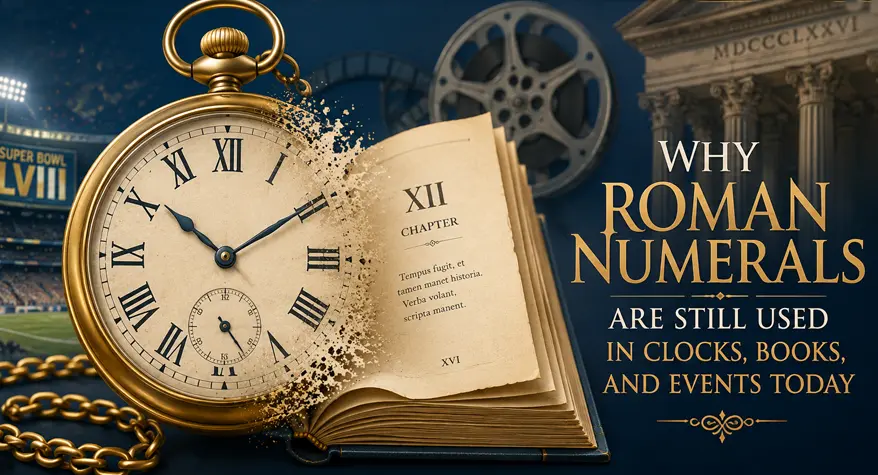
If you’ve ever looked at a clock face and seen letters instead of numbers, then you already know what Roman numerals look like in practice. But do you ever wonder why an ancient numbering system is still so prominent on the face of timepieces, chapter headings, film credits, and sporting event titles?
But nostalgia is not the only answer. There is a visual and cultural gravitas to Roman numerals that even the best copy of any form of Arabic numbering cannot match. They evoke long-held associations with conservatism, permanence, and middle-class respectability, all of which are precious commodities for publishers, designers, and event organizers alike.
Let us walk through exactly where and why Roman numerals are used on clocks, in books, and across so many other areas of modern life.
The Clock Face: Why Time Looks Different on Luxury Watches
Go into any luxury watch store, and you’ll spot it instantly. Most traditional watches have Roman numerals on their dials, and it isn’t merely a coincidence.
The tradition of using Roman numerals on clock faces dates back to the earliest mechanical clocks in Europe during the 13th and 14th centuries. Clockmakers at the time used Roman numerals because that was the dominant system for recording numbers in most of Europe. When printing and craftsmanship evolved, the style stuck — not because it was practical, but because it became associated with precision and timeless craft.
There is also a visual reason. Roman numerals fill the space of a clock face in a more balanced and symmetrical way than Arabic numerals do. The strokes of I, V, and X create a rhythm around the dial that feels intentional and clean. This is one of the key reasons roman numerals on watches and clocks have persisted for so long.
The Curious Case of IIII vs IV
If you look closely at clock faces, you will notice something unusual. Most of them display the number four as IIII rather than IV, which is the technically correct form.
Historians believe this goes back to aesthetic balance. Using IIII creates visual symmetry opposite the VIII on the other side of the dial. There is also a theory that IV was avoided to prevent confusion with the abbreviation for Jupiter — IVPITER — which was considered disrespectful in earlier centuries. Clockmakers kept the tradition, and it has never really changed.
Books and Publishing: Front Matter, Volume Numbers, and Series
Open almost any non-fiction, textbook, or academic book and turn to the pages just before Chapter One. Those pages — the foreword, preface, table of contents, and introduction — are almost always numbered in Roman numerals.
This is an intentional publishing convention, not an adornment. The use of Roman numerals in books serves a clear practical purpose.
Why Publishers Use Roman Numerals in Books
Publication of a book’s front matter is regarded as separate from the publication of the text. As the whole thing is generally done on the fly after the writing and editing of the message (the total page count of which fluctuates just as much as the message itself), if a publisher decides to number the page independently of the message itself using Roman numerals, then there is no need to retype the whole book.
In a practical way, it assists readers and indexers as well. If the reader is informed that a particular note is on page xiv, it is evident at once that it is in the front matter before the main part of the book.
Romans are also employed for volume and edition numbers in scholarly journals, legal codes, and encyclopedias. For example, in the edition of the Encyclopaedia Britannica, you frequently encounter references such as Volume XII or Edition III, and the use of the Roman numerals indicates the reliability of the series.
Events and Entertainment: Super Bowl, Olympics, and Film Credits
Some of the most-watched events in the world carry Roman numeral branding. The Super Bowl is the most obvious example. Since the third championship game in 1969, the NFL has used Roman numerals to number its championship games. Super Bowl LVIII took place in 2024, and the tradition shows no sign of stopping.
The reason the NFL adopted this convention is practical as well as stylistic. When a Super Bowl is played in January, two different years are involved — the season year and the game year. Roman numerals remove the date ambiguity and give each game a unique identity that feels more like a historic event than a regular-season fixture.
The Olympic Games follow a similar logic. The Summer and Winter Games are identified by Roman numerals in official documentation, and many organizing committees still use them in ceremonial branding to reinforce the connection to the ancient Greek origins of the games.
Hollywood and Film Sequels
Indeed, some of the most notable examples of the use of Roman numerals are the sequel titles and production slates. Films like Rocky II, The Godfather Part II, and Star Wars Episode VI utilize Roman numerals for their official title treatments. Likewise, it is very common to see the copyright date in credits expressed in Roman numerals, a practice that arose at least in part to hide a movie’s age when rebroadcast or syndicated on television.
These are all excellent examples of the modern uses of Roman numerals in popular culture.
Architecture, Monuments, and Cornerstones
The next time you walk past an older government building, courthouse, or university campus, look up at the cornerstone or the inscription above the entrance. You will almost certainly see a year carved in Roman numerals.
This has been standard practice in formal architecture for centuries. Roman numerals convey durability and civic dignity in a way that carved Arabic numerals rarely achieve. There is something about MCMXLVII chiseled into granite that feels more permanent than 1947, even though they represent exactly the same year.
War memorials, statues, dedication plaques, and public art installations continue this tradition. The numerals connect the structure visually to classical and Renaissance ideals of beauty and permanence.
Legal Documents, Monarchies, and Formal Nomenclature
Kings, queens, and popes have Roman numerals after their names to number them. Queen Elizabeth II, Pope John Paul II, and King Charles III are identified using Roman numerals. They are used to number groups of acts, clauses, sections, and sub-sections in government and law to delineate them from the number sequence used throughout the document body.
Roman numerals also categorize primary sections in court cases, bills, and amendments to the Constitution. This serves as a visual hierarchy by setting apart the structure and references to data.
Court cases, legislative bills, and constitutional amendments often use Roman numerals to number primary sections. This creates a visual hierarchy that distinguishes structural elements from referenced data.
Manual Conversion vs. Using a Tool
If you occasionally need to convert a number to Roman numerals or the other way around, doing it manually is possible — but it requires understanding the rules.
The system is additive and subtractive. You build numbers by combining values: M for 1000, D for 500, C for 100, L for 50, X for 10, V for 5, and I for 1. Subtraction applies when a smaller value appears before a larger one, so IV equals 4 and IX equals 9.
For simple numbers, this is manageable. But once you start working with larger values — say, converting 1987 or 2024 — the process becomes error-prone. MCMLXXXVII for 1987 requires several steps to construct correctly, and a single misplaced letter changes the value entirely.
Why a Dedicated Converter Saves Time and Reduces Errors
Manual approach:
- Requires memorizing the value table
- Each conversion needs a step-by-step calculation
- Easy to misplace subtractive pairs like CM, XC, or XL
- Not practical for batch conversions or unfamiliar numbers
Tool-based approach:
- Instant output with no calculation required
- Handles large numbers accurately
- Converts both directions — Roman to Arabic and Arabic to Roman
- Reliable for professional use in publishing, events, and legal work
The Roman Numeral Converter handles all of this without requiring you to remember a single rule. You enter the number, and the result appears immediately — correct every time.
Formatting Numbers Alongside Roman Numerals
There are also common circumstances in some publishing or documentation processes where you need to be able to make sure that numbers are formatted in the same way across a work that combines both systems. If you are writing a formal report or thesis that uses Roman numbering for some components but standard numbering for data, this can be tiresome.
When the rest of your document requires consistent number presentation, the Number Formatter is a straightforward tool for standardizing how values appear across different sections.
Conclusion: Old System, Enduring Purpose
Roman numerals are not a relic kept alive out of sentimentality alone. They serve specific, practical purposes across publishing, design, law, architecture, and entertainment — and they carry a visual authority that modern numeral systems have not replaced in formal contexts.
They appear as IIII on Swiss watch dials, on Super Bowl title cards, and on courthouse cornerstones. Roman numerals convey a sense of significance, tradition, and permanence. Their use often suggests that the designer, architect, or artist intended to evoke history, prestige, and enduring importance.
If you ever need to work with Roman numerals, whether for a book, event program, document, or design project, a Roman Numeral Converter can give you fast and accurate results without requiring any mental arithmetic.
For users who regularly work with online tools, using a dedicated Random Number Generator can significantly improve speed and accuracy. The Random Number Generator helps users complete this task instantly without manual effort, making the process more reliable and efficient.
Frequently Asked Questions
1. What is the use of Roman numerals on clocks and watches?
Roman numerals were standard on clocks’ dials when number systems based on the decimal system had yet to be invented and ultimately remained in widespread use through the course of the Middle Ages. Eventually, they became linked with craftsmanship, luxury, and classic design. Since they are both visually balanced and of high signal quality, they are still used on watches and clocks, especially high-quality models. This is precisely why Roman numerals are used on clocks even today.
2. Why do books use Roman numerals?
Publishers often number their front matter, including the table of contents, preface, and foreword, with Roman numerals to distinguish these parts from the rest of the book. This system enables an editor to settle the advance pages before renumbering the rest of the book, plus assists the readers and index writers in distinguishing this material from the main text of the book. These are the primary reasons for using Roman numerals in books.
3. Rationale for the use of Roman Numerals in the Super Bowl
The NFL first used the Roman numerals in Super Bowl III (1969). Since the Super Bowl takes place in January, using a regular year prior to the name can create confusion over whether a team is referring to the date of the year they played, or the year in which the game was played. Using Roman numerals helps each Super Bowl maintain a unique, timeless quality and helps to emphasize its historic significance.
4. Is it right to write the present year as a Roman numeral?
In Roman numerals, 2024 is written as MMXXIV. To build it out, you would do MM (2000) + XX (20) + IV (4). For any year, you should break the number into its building blocks and have a look through each part individually until you are comfortable. If doing it in mind is a little daunting, then click on the Roman Numeral Converter to do the job instantly.
5. Are Roman numerals still taught in schools today?
Absolutely! Roman numerals are taught in most primary schools in British, American, and European educational systems. Children usually learn them between the ages of 7 and 10. Knowing Roman numerals is very useful in daily living for telling time, referencing books, reading legal documents, movie credits, and using dates.