
The History of Large Numbers: From Trillions to Quadrillions and How We Name Them
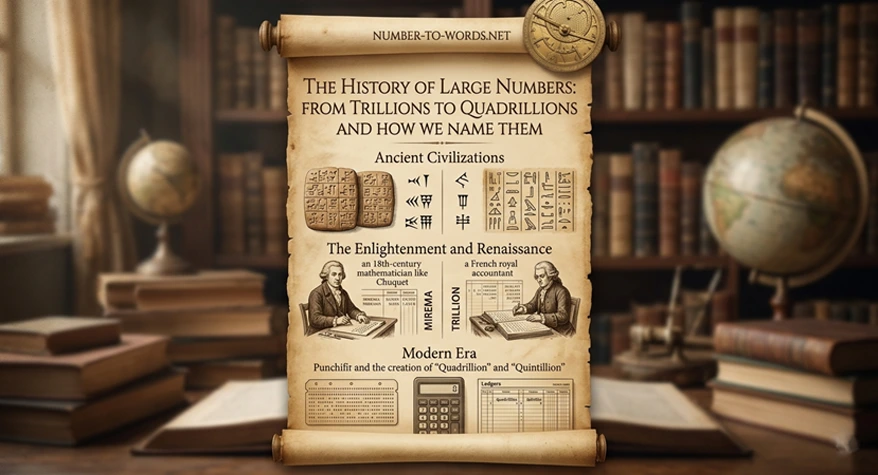
How did humans learn to name quantities larger than any flock, harvest, army, debt, or sky full of stars they could actually see?
The question of what comes after a trillion feels modern, almost spreadsheet-like, but the urge behind it is ancient. People have always needed language for “more than I can count.” First came fingers. Then tallies. Then trade, taxation, astronomy, banking, empire, and science pushed the use of number names far beyond daily life.
Large numbers are not just mathematical labels. They are cultural tools. A shepherd rarely needed quadrillion. An astronomer might. A banker may see a trillion in national debt. A computer scientist may think in petabytes. The names grew as human systems grew.
Large-number names have developed over time as people needed ways to describe quantities beyond everyday counting. Terms such as million, billion, trillion, and quadrillion are now widely used in mathematics, finance, science, and everyday language, but their meanings and usage have not always been identical across countries and periods.
The history of these names is particularly important when comparing the short scale and long scale, because words such as “billion” have had different meanings in different numbering systems.
Before Trillion: The Ladder Had to Be Built
The familiar climb starts gently: thousand, million, billion, trillion. It feels natural now. It was not always so.
The word million developed through Middle French milion and Old Italian milione, ultimately related to Latin mille, meaning “thousand.” The word came to represent 1,000,000, or a thousand thousand.
Later number names such as billion, trillion, and quadrillion were formed using related number prefixes and the “-illion” pattern.
Reference: Merriam-Webster: Million
This is why the sequence of million billion trillion seems logical to English speakers today. It is not a random decoration. It is a naming machine.
Look closely:
- bi- suggests two
- tri- suggests three
- quadri- suggests four
- quint- suggests five
- sext- suggests six
- sept- suggests seven
- oct- suggests eight
These roots help explain the structure of names such as billion, trillion, and quadrillion. Merriam-Webster traces billion to French bi- + -illion and trillion to French tri- + -illion.
The root provides a clue to the naming pattern, but it does not by itself determine the numerical value. The numbering scale determines the value.
The Short Scale: The System Used in Modern English Business
Here is where precision matters. In the short scale, each new major name after a million is 1,000 times larger than the previous one.
That means:
- million = 10⁶
- billion = 10⁹
- trillion = 10¹²
- quadrillion = 10¹⁵
- quintillion = 10¹⁸
So, in the short scale, names of large numbers advance by three zeros at a time. The short scale is used in American English and is now also standard in modern British English. Oxford, for example, defines a billion as 1,000 million while noting the older British meaning separately.
Because conventions can differ by language, country, and historical period, older or translated documents should be checked rather than assuming that every use of “billion” has the modern short-scale meaning.
That “three-zero jump” explains why trillion is followed by quadrillion. A trillion is one thousand billion. A quadrillion is one thousand trillion.
Clean. Efficient. Sometimes misleading.
The Long Scale: Where Billion Once Meant Something Else
The long scale works differently. In that system, each “-illion” name is based on powers of one million, not powers of one thousand. A long-scale billion is a million million, or 10¹². That is what short-scale English calls a trillion.
This difference has caused real confusion in history, diplomacy, finance, and translation. The same word could point to a different value depending on the country and period.
The difference between the short and long scales has historical roots in European naming conventions. Merriam-Webster explains that billion was originally used for a million million, or 10¹², before a later French convention used billion for 10⁹. The newer system was adopted in American English during the 19th century and became increasingly common in Britain from the 1950s.
Oxford also records the older British meaning of billion as one million million and the older British meaning of trillion as 10¹⁸.
Reference: Merriam-Webster: Billion
Reference: Oxford Learner’s Dictionaries: Billion
That is why anyone working with older documents, European contexts, or multilingual financial material should not treat “billion” as harmless. Ask the system. Then read the number.
A Practical List of Large Number Names
For modern English readers, the short scale is the standard convention, but the correct way to write large numbers in words can also depend on the numbering system and context. Here is a list of large numbers in order with values using the short scale:
If you need to convert a specific number into written words, you can use our Number to Words Converter.
- Million = 1,000,000 = 10⁶
- Billion = 1,000,000,000 = 10⁹
- Trillion = 1,000,000,000,000 = 10¹²
- Quadrillion = 1,000,000,000,000,000 = 10¹⁵
- Quintillion = 1,000,000,000,000,000,000 = 10¹⁸
- Sextillion = 10²¹
- Septillion = 10²⁴
- Octillion = 10²⁷
- Nonillion = 10³⁰
- Decillion = 10³³
Past this point, names exist, but ordinary speech begins to break down. Scientists usually prefer powers of ten. It is shorter. Less theatrical. Far safer.
So, What Comes After Trillion?
In the short scale, the answer is quadrillion.
A trillion has 12 zeros. A quadrillion has 15. That jump follows the thousand-fold rhythm of the short scale. If someone asks what comes after a trillion, the immediate modern English answer is quadrillion, followed by quintillion, sextillion, septillion, and octillion.
But the historically honest answer has a footnote: “Which numbering scale are you using?”
That footnote matters. In short-scale English, trillion is 10¹². In older long-scale usage, trillion referred to 10¹⁸. Same spelling. Different size. A dangerous little word when money, population models, astronomy, or government figures are involved.
Why Large Number Names Became Necessary
As mathematics, commerce, government, astronomy, and science developed, people needed ways to describe quantities far beyond everyday counting.
Named values such as million, billion, trillion, and quadrillion made very large quantities easier to communicate in language. However, as numbers became larger, scientific notation became increasingly useful because it represents the exact magnitude without relying on regional naming conventions.
The Modern Problem: Big Numbers Travel Badly
Large numbers now move across borders in seconds. Financial reports, investor decks, crypto supplies, national budgets, research papers, and AI training statistics may all use huge figures. The reader may not share the writer’s numbering habit.
That is where names of large numbers become more than trivia. They become a translation issue.
A U.S. analyst reads billion as 10⁹. A reader trained in long-scale conventions may hesitate. A student may know trillion from headlines but not quadrillion.
The best practice is simple:
- Write the number in digits.
- Add the name only when helpful.
- Use powers of ten for scientific or technical contexts.
- Clarify the scale when documents cross regions.
Final Thoughts
The names of large numbers developed from historical language patterns and different numbering conventions. Million, billion, trillion, and quadrillion are now familiar terms, but their meanings have not always been consistent across countries and periods.
In modern short-scale English, quadrillion comes after trillion, with each major step after million increasing by a factor of 1,000. When working with historical or international material, however, checking the numbering scale is essential.
Frequently Asked Questions
1. What is the difference between a trillion and a quadrillion?
A trillion equals 1,000 billion, while a quadrillion equals 1,000 trillion in the short scale. A trillion has 12 zeros, while a quadrillion has 15 zeros.
2. Why do large numbers have names like trillion and quadrillion?
Large-number names make very large quantities easier to communicate in ordinary language. Names such as million, billion, trillion, and quadrillion are used in mathematics, finance, science, and everyday communication.
3. What is the short scale numbering system?
The short scale is the modern system in which each new major number name is 1,000 times larger than the previous one. For example, billion is 10⁹, trillion is 10¹², and quadrillion is 10¹⁵.
4. Why are large numbers important today?
Large numbers are used in economics, astronomy, computing, population studies, finance, and scientific research to describe quantities that are far beyond everyday counting.
5. Are there numbers bigger than a quadrillion?
Yes. Numbers continue beyond quadrillion with names like quintillion, sextillion, and septillion. Mathematics allows numbers to grow infinitely larger without limit.